The Arab Spring in Libya


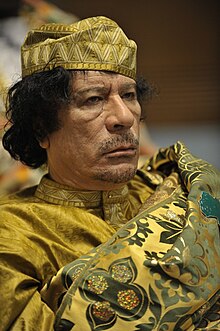
Former Libyan President Muammar Gaddafi

On February 15th, 2011, the Arab Spring arrived in Libya. The Libyan people had tired of Muammar Gaddafi’s 33 year reign as dictator, and sought to emulate the Egyptian and Tunisian protests. Protests occurred in Benghazi, Bayda, Derna and Zintan as the Libyan people expressed their anger towards the tyranny. The results of the Tunisian and Egyptian revolutions were a large source of inspiration for Libyan protesters  fueling the underlying tensions towards Gaddafi’s reign.

The National Transitional Council was established on February 27th to consolidate efforts to overthrow the Libyan government. The group, although filled with many different factions, supported common goals to coordinate resistance efforts to wrest Libyan control. The NTC was seen as an integral part in the campaign, as they also provided communication efforts to the outside world.

The Libyan immediately responded with high levels of violence. Snipers, artillery, helicopters and warships were soon used against protesters. Under Gaddafi’s orders, hospitals were stormed and injured protestors were summarily killed. Gaddafi also hired ‘death squads’ to attack protesters in Tripoli, giving permission to shoot all who disobeyed orders. Thousands of protesters were killed in these heinous acts of violence.

The international outcry was immediate, as both the United Nations Security Council and NATO sought to enforce a no-fly zone in Libyan airspace to stop Gaddafi’s forces from killing civilians. On March 17th, 2011, the UNSC approved a no-fly zone that was immediately carried out. From May, 2011 until September, 2011, NATO airstrikes attacked key targets throughout Libya. However, these were severely limited to avoid civilian casualties. Control of ground troops was maintained by coalition forces.

Egyptian Constitutional Referendum

On February 15th, the Egyptian military had appointed Tareq al-Bishry, a retired judge, to head the committee to draft constitutional reforms. The Supreme Council vowed to rewrite the constitution in 10 days and then put the changes to a referendum within 2 months. The Constitutional Referendum was held on March 19th, and there was great opposition to the proposed changes by well-known political opposition leaders. Many felt like the changes to the constitution did not sufficiently address the concerns made by the Egyptian people, and some suggested that the entire constitution be rewritten in light of recent events. The constitutional reforms, however, were voted upon by the Egyptian people and passed with 77.2% of the vote.

A line of voters for the March 19 Constitutional Referendum in Cairo

"I Draw Legitimacy from You" - Essam Sharaf's Appointment

On March 3rd, 2011, Egyptian protestors were still unhappy with the progress of reforms. Protests in the streets of Egypt were still ongoing, and many were concerned with the slow speed with which changes were being made. In response to public demands, Prime Minister Ahmed Shafik resigned.

Former Egyptian Prime Minister Ahmed Shafik

Essam Sharaf was chosen as the successor to Ahmed Shafik for his previous experience in the Egyptian government as the Minister of Transportation as well as his outspoken support of the protests in Tahrir Square. Sharaf was seen as an active leader within the Egyptian revolution, and it was hoped that this move by the Supreme Council would help pacify the protesters.

Prime Minister Essam Sharaf

Sharaf’s appointment was seen as a large victory for the Egyptian protestors. Sharaf was a man that they trusted, and whom they believed would ensure the necessary transition towards democracy. Protestors were ecstatic when Essam Sharaf spoke in their midst in Tahrir Square upon his appointment.


The Egyptian Supreme Council of the Armed Forces

The Supreme Council of the Armed Forces was delegated power after Hosni Mubarak’s resignation. The Supreme Council consists of 20 senior officers in the Egyptian military, and it is usually headed by the President of Egypt. As there is no current President, the current leader of the Supreme Council is Mohamed Hussein Tantawi.

Head of the Supreme Council of the Armed Forces Hussein Tantawi

On February 13, 2011, the Supreme Council of the Armed Forces issued a televised statement to the people. This statement included the immediate reforms made by the interim government. The reforms are as follows:
  • Egyptian constitution suspended
  • The Supreme Council would hold power for six months or until elections
  • Both houses of parliament would be dissolved
  • The Supreme Council would issue laws during interim period
  • A committee would be created to reform constitution and set rules for referendum
  • Caretaker PM Ahmed Shafiq's cabinet would work until new cabinet formed
  • The Supreme Council would soon hold presidential and parliamentary elections
  • All international treaties to be honored

A Second Regime Falls: The End of Hosni Mubarak's Reign

Massive demonstrations continued after January 25th as the Egyptian Revolution was in full effect. In an attempt to quell the protests, the Egyptian government implemented a massive internet and mobile services shutdown on January 28th. This was a response to the dozens of Facebook groups and events that were created as well as the thousands of tweets concerning the protests. However, this had a very small impact on the overall course events, and was seen as a measure that was taken much too late.


January 25th Protests in Egypt

Hundreds of thousands of protestors filed in the streets on the ‘Friday of Anger’ protests after Friday prayers 
on January 28th. In an attempt to terrorize protestors, then-Minister of Interior Habib El Adly allegedly ordered prisons to be emptied, allowing the prisoners to escape onto the streets. The military was soon deployed, sparking fear of violent eruptions. Hosni Mubarak then addressed the protestors, promising to form a new government. This move was not enough, and protests continued. On January 29th, the military was allegedly given orders to fire live ammunition at the protestors, but they refused.


Friday of Anger protests on January 28th

On February 1st, Mubarak made another televised statement, pledging to not run for another term as president and promising political reforms. He claimed that he would stay in office to oversee the transition towards a peaceful government. It was not until 10 days later, after considerable pressure from the Egyptian people, that Mubarak finally stepped down. At 6:00 local ti    me, Vice President Omar Suleiman announced Mubarak’s resignation. The Supreme Council of Egyptian Armed Forces was delegated leadership.